
The best AI tools for blogging in 2025 are not just text generators; they are integrated platforms that help blogs identify topical opportunities, structure content according to real search engine demand, generate high-quality drafts, optimize for ranking factors, manage internal linking, track performance over time, and adapt existing content to changing search trends.
In practical terms, the most effective AI stack is a combination of research-oriented systems, SERP-aware editors, internal optimization engines, and analytics tools that together reduce guesswork and align content production with how major search engines (especially Google) evaluate relevance, authority, and completeness in 2025.
How Modern Blogging Stacks Are Structured

Most high-performance blogging operations no longer use a single AI tool. They use a purpose-built stack where each tool focuses on a discrete part of the publishing lifecycle:
| Stage | Tool Type | Outcome |
| Topic Identification | Intent & Research AI | Correct article purpose |
| Competitor Analysis | SERP Modeling AI | What needs to be covered |
| Draft Generation | LLM Editor | Content creation speed |
| Optimization | SEO AI Editor | Alignment with ranking signals |
| Internal Structure | Linking & Sitescope AI | Crawl efficiency and authority |
| Post-Publishing | Auditing & Update AI | Sustained ranking |
This modular approach enables blogs to reduce waste, improve relevance, and increase organic traffic with fewer total published posts.
13 Core AI Tools Used by Bloggers in 2025
Below is a detailed, expanded look at the most widely adopted tools in blogging ecosystems as of 2025, why each matters, and how it fits into a high-impact workflow.
1. ChatGPT and Other Advanced Large Language Models

ChatGPT remains a central drafting engine because of its capacity to generate coherent long-form text quickly and adapt to detailed editorial constraints. By 2025, its role matured from raw text generation to a structured editor:
- Strengths: Rapid drafting, tone adaptation, rewrite capabilities, and multilingual support.
- Limitations: No intrinsic SERP understanding; needs external direction.
- Usage: Drafting sections, expanding outlines, improving readability.
Professional bloggers in 2025 use ChatGPT in conjunction with SEO outlines generated elsewhere. They feed the model detailed SERP-derived structures to ensure the content matches searcher expectations.
2. Surfer SEO – AI-Driven Content Optimization
Surfer SEO is arguably the most widely adopted SEO editor among professional bloggers.
It analyzes current top-ranking pages and recommends structural elements, term usage, headings, and entity coverage – shifting focus from simple keyword density to deeper topical relevance.
| Feature | Practical Application |
| Content Editor | Real-time optimization against SERP models |
| SERP Analyzer | Competitive benchmarking |
| NLP Context Terms | Semantic completeness |
| Outline Builder | Faster research-based planning |
Surfer’s major strength is its ability to quantify what top competitors cover, reducing guesswork.
3. Clearscope – Precision for Relevance
Clearscope offers a tighter set of term suggestions and quality benchmarks.
Unlike tools that provide hundreds of suggestions, Clearscope focuses on relevance scoring and importance, making it ideal for niches with strict quality signals.
| Metric | Use Case |
| Content Grade | Final quality control |
| Competitor Relevance | Narrow niche benchmarking |
| Key Concept Scoring | Depth assurance |
In regulated or high-oversight niches like health or finance, Clearscope helps ensure content adheres to stricter topical expectations.
4. Jasper AI – Brand Consistency at Scale
Jasper shifted toward editorial governance and brand voice control in 2024–2025. For multi-author blogs, maintaining consistent style, terminology, and voice is critical to perceived authority and audience loyalty.
| Feature | Benefit |
| Tone Templates | Brand uniformity |
| Team Collaboration | Editorial alignment |
| Workflow Integration | Template-based creation |
Jasper is valuable when content scale and team coordination matter more than speed.
5. Frase – Intent & Question Mapping
View this post on Instagram
Frase excels at understanding searcher intent and extracting question clusters relevant to keywords. It draws from SERPs, related searches, and community Q&A, identifying what people actually want to know.
| Output | Blogging Impact |
| Question Clusters | FAQ sections |
| Intent Summary | Article framing |
| Topic Mapping | Depth planning |
Frase is typically used before outline creation – it tells writers what angles the article must answer.
6. MarketMuse – Strategic Topical Authority Planning
MarketMuse operates at the macro content strategy level. Instead of focusing on single pages, it analyzes entire sites to pinpoint topic clusters, coverage gaps, and authority opportunities.
| Capability | Result |
| Topic Gap Analysis | New article ideas |
| Cluster Recommendations | Strategic planning |
| Authority Scoring | Competitive positioning |
Blogs with hundreds of pages use MarketMuse to plan their editorial calendar with data rather than intuition.
7. Semrush Content AI – Integrated SEO & Competitive Insights
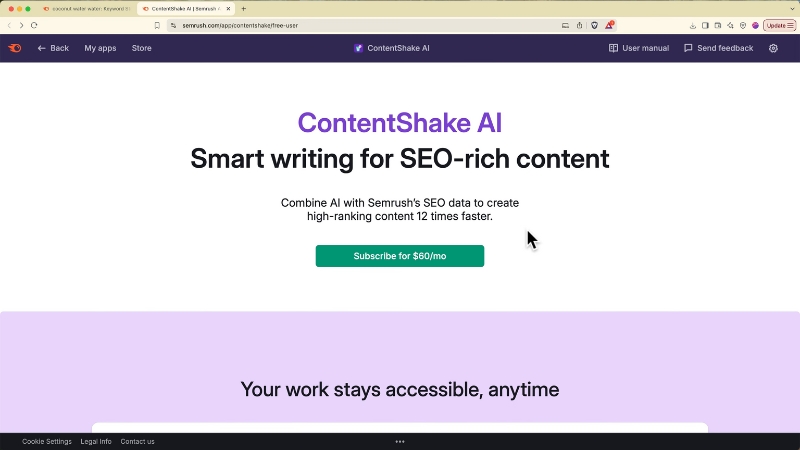
Semrush’s Content AI module blends keyword research with user intent profiling and competitor analysis, positioning it as a hybrid tool between planning and optimization.
| Strength | Function |
| Keyword Clusters | Topic groupings |
| Intent Signals | Correct article goals |
| Competitor Metrics | SERP difficulty |
Semrush is often an early-stage planning tool, helping bloggers avoid low-opportunity keywords.
8. Ahrefs Content Explorer + AI Extensions
Ahrefs combines large backlink data with AI to identify content gaps based on performance signals:
- Backlink Patterns: What pages earn links and why.
- Traffic Estimates: Data-driven demand signals.
- Content Gap Analytics: What competitors rank for that you don’t.
Ahrefs is particularly strong for data-heavy topic validation and historic performance context.
9. Link Whisper – AI Internal Linking Assistant
@affitor.ai Overview of AI Link Whisper Tool : 1. Automatic internal link suggestions 2. Automatic linking by keywords 3. Orphaned posts detection 4. Detailed link reports 5. Integration with SEO plugins #aitools #Affitorai #Affitor #linkwhisper #linkwhisperreview #seotools ♬ Epic Music(863502) – Draganov89
Internal linking has a direct impact on crawl equity and topical authority. Link Whisper uses semantic analysis to recommend high-value internal links:
| Function | SEO Impact |
| Automated Suggestions | Improved crawl paths |
| Orphan Page Detection | Coverage completeness |
| Link Authority Distribution | Stronger rankings |
This tool is frequently used after publication to ensure the site architecture reinforces SEO goals.
10. WordLift – Semantic SEO & Knowledge Graphs
WordLift focuses on building a semantic knowledge layer inside a blog. It analyzes entities, relationships, and structured data to create internal knowledge graphs that help search engines understand a site’s topical focus.
- Entity Linking: Improves semantic clarity.
- Structured Metadata: Enhances rich results.
- Topic Relationships: Strengthens context signals.
WordLift is especially useful for technical or educational blogs where entity structure influences visibility.
11. Surfer Local & Local SEO AI

For blogs tied to local audiences or business blogs with regional focus, Surfer Local and similar local AI tools integrate local search signals, maps rankings, and geo-specific intent data.
Local SEO is often overlooked in blogging, but it drives consistent traffic for regionally targeted topics.
12. ContentCal & Editorial Workflow AI
These tools add AI into editorial planning and publishing workflows. They help teams schedule, track revisions, and analyze performance over time.
While not SEO-centric, workflow AI reduces bottlenecks and improves content throughput quality.
13. GrowthBar – Simple, All-Around SEO AI
GrowthBar is an all-in-one SEO assistant with AI writing prompts built alongside keyword difficulty, backlink overviews, and rank tracking. It’s often used by smaller blogs that need multiple capabilities in a single interface without enterprise complexity.
Practical Workflow Example in 2025
A modern blogging workflow using AI tools in 2025 looks less like “write → publish” and more like “research → outline → draft → optimize → structure → publish → audit.” Each step leverages different tools:
- Intent & Demand: Use Frase + Semrush to validate intent and search volume.
- Outline: Use Surfer SEO or Clearscope to create structured content templates.
- Drafting: Generate draft with ChatGPT or Jasper using the outline.
- Optimization: Refine with Surfer SEO, Clearscope, and WordLift entities.
- Internal Linking: Apply Link Whisper recommendations.
- Publish & Workflow Tracking: Use ContentCal or equivalent.
- Post-Publish Audit: Quarterly content audits with SEO auditing AI.
- Long-Term Planning: Use MarketMuse to identify new topic clusters.
Conclusion
In 2025, AI tools for blogging are not interchangeable luxury add-ons – they are integral parts of a data-driven publishing ecosystem. High-performing blogs use AI for research, intent analysis, drafting, optimization, semantic structuring, and ongoing refinement.
The tools listed above each fill specific needs in the lifecycle of a blog post, and when combined strategically, they reduce waste, improve relevance, and deliver measurable traffic gains over time.
The future of blogging is not a single AI writer but an interconnected stack that aligns content production with how today’s search engines interpret and serve content.