
In 2025, WordPress sites rank better than generic blog websites in the vast majority of competitive search results, not because WordPress is inherently “SEO magic,” but because its technical flexibility, performance control, and ecosystem make it easier to meet Google’s current ranking requirements at scale.
Blog websites built on closed or simplified platforms can still rank, but they increasingly hit structural limits around speed, schema, content architecture, and long-term optimization.
The ranking gap is not about content quality alone anymore. It is about how efficiently a site can implement and maintain modern SEO standards over time.
What “Blog Websites” Actually Mean in 2025

The term “blog website” has become vague. In 2025, it usually refers to sites built on simplified or closed systems such as Wix, Squarespace, Blogger, Medium, Substack, Ghost-hosted instances, or custom lightweight blog builders with limited backend access.
These platforms prioritize ease of use, fast setup, and minimal maintenance. They abstract away server control, database structure, caching layers, and in many cases even URL logic.
That abstraction is convenient for publishing, but it creates constraints. You cannot fully control how pages are rendered, how JavaScript is loaded, how schema is injected at scale, or how content types interlink.
As Google’s ranking systems increasingly evaluate site-wide quality signals rather than individual pages in isolation, those constraints matter more than they did five years ago.
What a WordPress Site Is Today, Not in 2015
WordPress in 2025 is not the same platform people criticized a decade ago for being slow or bloated. It now powers roughly 43 percent of all websites globally, according to W3Techs 2024–2025 data, and dominates the content-heavy segment of the web.
That dominance matters because Google’s crawling, indexing, and rendering systems are implicitly optimized around common WordPress patterns.
Modern WordPress sites typically run on PHP 8.2+, use server-side caching, object caching, edge CDNs, optimized themes, block-based editors, and structured content models.
More importantly, WordPress allows full control over technical SEO elements that Google increasingly weighs: internal linking logic, custom schema types, crawl budget optimization, indexation rules, and performance tuning down to the server level.
How Google Ranks Sites in 2025
Google’s 2025 ranking systems emphasize fewer novelty signals and more consistency signals. Core updates over the past two years have reinforced this direction. Ranking is no longer about isolated keyword targeting.
It is about whether a site demonstrates sustained topical authority, technical reliability, and user satisfaction across hundreds or thousands of URLs.
Key ranking dimensions now include:
- Site-wide content coherence rather than page-level relevance
- Crawl efficiency and index stability
- Core Web Vitals are measured over time, not snapshots
- Structured data accuracy and coverage
- Internal link logic that reflects real topical hierarchies
- Historical trust signals, such as update patterns and error rates
Platforms that make these elements difficult to manage tend to fall behind, even if individual articles are well written.
Technical SEO Control: The Core Difference
The biggest ranking difference between blog websites and WordPress sites is technical control. WordPress allows direct manipulation of nearly every SEO-relevant layer. Most blog platforms do not.
| Technical Element | Generic Blog Platforms | WordPress Sites |
| URL structure control | Limited or fixed | Full control |
| Schema customization | Minimal or preset | Fully customizable |
| Indexation rules | Basic | Granular |
| Crawl budget optimization | Not accessible | Fully manageable |
| Server-level caching | Platform-dependent | Configurable |
| JavaScript rendering control | Limited | High |
| Log file analysis | Not available | Available |
When Google encounters rendering delays, unnecessary scripts, or bloated page structures, it does not penalize intentionally, but it does de-prioritize inefficient pages over time.
WordPress sites can remove or optimize those inefficiencies. Blog platforms often cannot.
Performance and Core Web Vitals in Practice
View this post on Instagram
Core Web Vitals remain a ranking factor in 2025, but their role has matured. Google now evaluates performance trends over time rather than isolated scores. WordPress sites, when properly configured, are better suited to meet these expectations consistently.
Simplified blog platforms often load unnecessary scripts globally, inject third-party assets without control, and rely heavily on client-side rendering. This leads to unstable Largest Contentful Paint and Interaction to Next Paint metrics, especially on mobile.
A well-optimized WordPress site using server-side rendering, edge caching, and selective script loading consistently outperforms closed platforms under real-world conditions.
| Metric Stability (Mobile) | Blog Platforms | WordPress |
| LCP consistency | Moderate | High |
| INP optimization | Limited | Advanced |
| CLS control | Platform-dependent | Strong |
| Script deferral | Limited | Full |
This does not mean every WordPress site is fast. It means WordPress allows speed to be engineered, while many blog platforms enforce speed ceilings.
Content Architecture and Topical Authority

In 2025, topical authority is not a buzzword. It is a measurable ranking pattern. Google increasingly evaluates whether a site covers a topic comprehensively, with logical internal linking and clear content relationships.
WordPress excels here because it supports:
- Custom post types
- Taxonomies beyond basic categories
- Programmatic internal linking
- Content hubs and silos
- Controlled pagination and archives
Generic blog platforms tend to flatten content. Articles exist in isolation, connected weakly by tags or chronological feeds. That structure limits a site’s ability to signal expertise depth across a subject area.
Over time, WordPress sites naturally accumulate stronger topical signals because they can scale structured content without rewriting the entire site architecture.
Indexation, Updates, and Long-Term Stability
Another overlooked factor is index stability. Google rewards sites that maintain clean indexes over time. WordPress allows precise control over what gets indexed, updated, merged, redirected, or removed.
Blog platforms often generate:
- Duplicate URLs
- Tag archives with thin content
- Auto-generated pages without a clear purpose
- Limited redirect logic
These issues rarely cause immediate ranking drops, but they slowly dilute site-wide quality signals. In competitive niches, that dilution becomes visible within 12 to 24 months.
WordPress sites can aggressively prune, consolidate, and restructure content as search intent evolves. That adaptability is a ranking advantage.
Real-World Ranking Outcomes in 2025
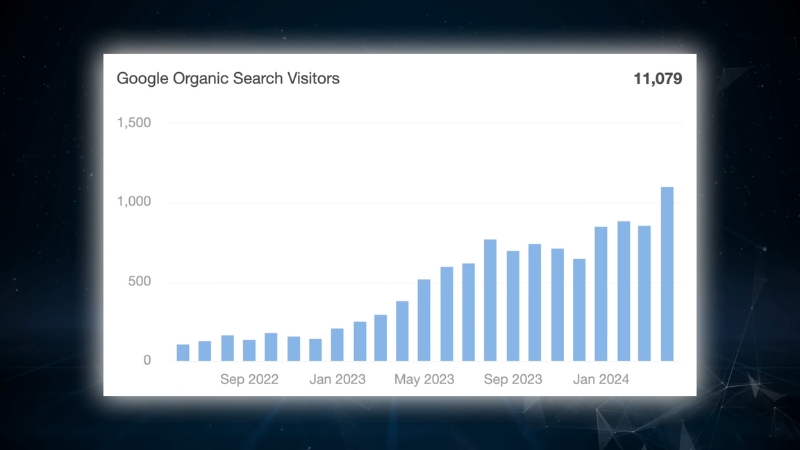
Looking at competitive informational niches in 2024–2025, such as health, finance, travel, and technology, WordPress sites dominate first-page results. Independent analyses of SERPs consistently show WordPress powering a disproportionate share of top-ranking domains relative to its overall web share.
This is not because WordPress content is better written by default. It is because WordPress sites are better equipped to align with Google’s technical and structural expectations at scale.
Simpler blog platforms still rank well for:
- Personal blogs
- Low-competition niches
- Opinion-based content
- Single-topic newsletters
They struggle as soon as topical breadth, internal structure, or technical refinement becomes necessary.
When a Blog Platform Can Still Compete
There are cases where a non-WordPress blog website performs well. These are usually scenarios where:
- The site targets a narrow topic
- Publishing frequency is low
- Competition is limited
- Brand authority exists outside search
- Traffic sources are diversified
In these cases, platform limitations matter less because Google does not need to evaluate complex site-wide signals. Once scale enters the picture, limitations surface.
WordPress Is Not Automatically Better, But It Is More Capable
@wordpress 5 undeniable reasons why WordPress is the best website platform for SEO Whether you’re focused on Google SEO or AI SEO, @Kate Smoothy | SEO Specialist is spilling all the benefits for your SEO strategy. #WebsiteSEO #GoogleSEO #WordPressSEO #AISEO #SearchEngineOptimization ♬ original sound – WordPress
It is important to be precise. WordPress does not rank better by default. Poorly configured WordPress sites can underperform even basic blog platforms. The difference is potential.
WordPress gives site owners the tools to meet modern SEO requirements fully. Blog platforms often do not.
Ranking in 2025 is not about shortcuts. It is about infrastructure, consistency, and long-term optimization capacity. WordPress aligns with those needs more closely than any other mainstream CMS.
Bottom Line
In 2025, WordPress sites rank better than generic blog websites because they allow full technical control, scalable content architecture, stable performance optimization, and long-term index management. Google’s ranking systems increasingly reward these characteristics.
Blog platforms remain viable for small, focused projects, but they impose ceilings that become visible as competition increases. The ranking difference is structural, not stylistic, and it widens the longer a site operates at scale.