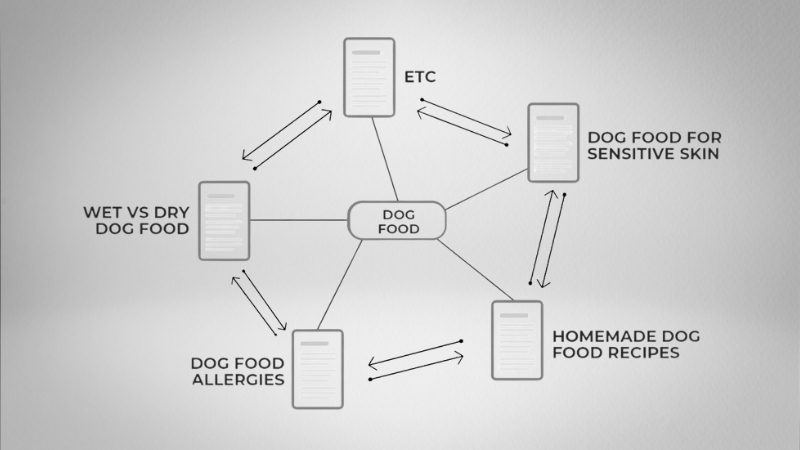
An effective internal linking strategy in 2025 is no longer about “spreading links evenly” or blindly adding related posts at the bottom of articles. The real goal is building topic authority, where Google clearly understands what your site is about, which pages are central, and which pages exist to support those main topics.
The concrete truth is this: blogs that structure internal links around topic clusters consistently outperform blogs that link randomly, even when the content quality is similar.
Internal links now shape how search engines interpret topical depth, crawl priority, user paths, and even ranking stability. When done correctly, internal linking turns a collection of articles into a structured knowledge system instead of a loose pile of posts.
1. What Internal Linking Really Means in Modern SEO
Internal links are no longer just navigation aids. In Google’s modern ranking systems, they function as context signals, authority routes, and relationship markers between pages.
Each internal link tells Google two things at once: what the destination page is about, and how important it is within the site’s overall structure.
When internal linking is weak or random, Google has to guess which pages matter most. When linking is intentional, Google sees:
- Which topics are central
- Which pages support those topics
- How subtopics relate to core subjects
- Which pages deserve crawl and ranking priority
This is exactly how topic authority is built at the structural level, not just through content alone.
2. Topic Authority vs Page Authority (Why This Matters More in 2025)
In the past, SEO focused heavily on ranking individual pages. Today, Google increasingly evaluates entire topic clusters.
A single strong article is no longer enough. Instead, the algorithm looks for:
- depth of coverage
- internal relationship strength
- consistency of thematic focus
- user navigation flow across related pages
A blog that covers “equine nutrition,” for example, will not build real authority with one article on feed.
It needs multiple interconnected pages on forage, minerals, hydration, metabolic conditions, seasonal feeding, and performance nutrition – visibly linked together in a logical hierarchy.
Internal linking is what makes this hierarchy visible to search engines.
3. The Core Structure That Builds Topic Authority
At the center of topic authority is a simple structural model:
- Pillar page → the main, authoritative overview of a topic
- Supporting articles → detailed deep dives on subtopics
- Cross-links between related subtopics
This creates a network where authority flows outward from the main page and then circulates back through related content. The structure tells Google: “This site doesn’t just mention this topic. It fully explains it.”
Topic Authority Structure
| Page Type | Role | Internal Link Behavior |
| Pillar page | Central authority | Links out to all subtopics |
| Supporting pages | Depth and coverage | Link back to the pillar |
| Lateral content | Related relevance | Cross-links between siblings |
Without this structure, even high-quality articles struggle to signal long-term topical specialization.
4. Anchor Text Strategy That Actually Builds Relevance
View this post on Instagram
Anchor text is no longer about exact-match keywords. In fact, over-optimization reduces trust and can suppress rankings. In 2025, Google will better understand partial match, semantic match, and natural language anchors.
- Describe the destination clearly
- match user intent
- fit naturally into the sentence
- vary across different links
- Repeat the same keyword every time
- Use vague phrases like “click here.”
- feel forced or mechanical
Natural language anchors reinforce relevance without triggering spam signals.
Strong vs Weak Anchors
| Strong Anchor | Why It Works |
| “hydration strategies for endurance horses” | Descriptive and intent-driven |
| “laminitis risk during spring grass flush” | Topic + seasonal context |
| “electrolyte imbalance in heat stress” | Physiological relevance |
| Weak Anchor | Why It Fails |
| “click here” | No context |
| “learn more” | Zero topical value |
| Best feeding guide 2025 ultimate.” | Over-optimized and spammy |
5. How Many Internal Links Per Article Is Optimal
There is no fixed magic number, but there is a range that consistently performs well for long-form blogging:
- Short posts (800–1,200 words): 3–6 internal links
- Standard long-form (1,500–2,500 words): 6–10 internal links
- Authority-length content (3,000+ words): 10–18 internal links
What matters is not the raw number, but placement and relevance. Links placed mid-paragraph at points of genuine topical overlap outperform:
- footer link lists
- sidebar widgets
- automated “related posts” blocks
Google evaluates link placement as a quality signal, not just a quantity metric.
6. Crawl Flow: How Internal Links Control Indexing Priority
Crawl behavior is priority-based, and that priority is determined mainly by internal linking strength. Pages that receive more internal links from prominent locations such as the homepage, category hubs, and pillar pages are crawled more frequently and treated as more important.
Pages buried deep in the structure, with only one or two weak internal references, are crawled less often or sometimes not at all.
This means your internal linking strategy directly controls how fast Google discovers new content, how often it revisits important pages, and which URLs receive ranking priority. Even exceptionally high-quality pages can remain invisible if they are structurally isolated.
Google interprets weak internal linking as a signal that the page does not matter much within the site’s ecosystem.
How Internal Linking Affects Crawl Priority
| Internal Link Condition | Crawl Behavior Result |
| Linked from homepage or pillar | Crawled frequently |
| Linked from multiple related articles | Crawled regularly |
| Linked only once deep in the site | Crawled infrequently |
| Orphaned page with no links | Often not crawled at all |
7. How to Use Internal Links to Revive Old Content
Internal linking is one of the most reliable ways to revive declining or stagnant content without rewriting it from scratch. When a new article links back to older, relevant content, Google receives a strong freshness signal.
That old page is recrawled, re-evaluated, and often partially re-ranked based on its updated position within the topic cluster.
This process does not just restore visibility. It reconnects older content to your active authority network. Rankings often stabilize or rise again, especially when the revived page is still topically relevant but had simply fallen out of the internal link flow.
Instead of constantly publishing new articles just to replace aging ones, high-performing blogs now operate on a reinforcement model. New content strengthens old content. Old content stabilizes new content through topical consistency.
This is one of the safest long-term SEO growth mechanisms because it compounds existing authority instead of fragmenting it.
What Happens When Old Content Is Reinforced
| Before Internal Reinforcement | After Internal Reinforcement |
| Infrequent crawling | Regular recrawling resumes |
| Ranking decay | Ranking stabilization or lift |
| Low internal visibility | Re-enters the authority network |
| Weak topical relevance | Regains topical context |
8. Internal Links and User Behavior Signals
Internal links do not only guide search engines. They strongly shape how real users experience your site.
When internal links lead naturally from one relevant topic to the next, users stay longer, read deeper, and interact more meaningfully with your content. These behavioral signals directly reinforce ranking stability across entire topic clusters.
Well-placed internal links increase time on site because users find clear next steps instead of returning immediately to search results. They increase pages per session because readers move naturally through connected learning paths.
They reduce bounce rate because users land on a page that properly feeds into additional context. They increase scroll depth because readers recognize that the site consistently delivers value.
User Signals Influenced by Internal Linking
| Behavior Signal | Impact on Rankings |
| Time on site | Signals content relevance |
| Pages per session | Signals topic satisfaction |
| Bounce rate | Signals match with search intent |
| Scroll depth | Signals the content’s usefulness |
This is why link relevance matters more than link volume. One strong internal link that leads to a logical follow-up read sends a more powerful quality signal than ten random links that users ignore.
9. Common Internal Linking Mistakes That Kill Topic Authority
@kasimjaved_kj Understanding SEO is about topical authority and not specific keywords #seomyths #seo #seoagency #marketingagency ♬ original sound – Kasim Javed
Many otherwise high-quality blogs unknowingly damage their topic authority through structural linking mistakes. One of the most common problems is linking only to the homepage instead of to relevant deep content. This prevents authority from flowing properly into internal topic hubs.
Another frequent mistake is neglecting older content. When new articles never link back to old ones, the old pages slowly fall out of the crawl and ranking ecosystem.
Repeating the same anchor text across dozens of pages weakens natural language relevance and can trigger devaluation. Orphaned pages with no inbound links often disappear entirely from meaningful index visibility.
Relying exclusively on “related posts” plugins is also structurally weak, because those links are often random, template-based, and placed in positions that users ignore. Over-linking within the first paragraph damages readability and dilutes weight distribution before Google even reaches the core substance of the article.
High-Impact Internal Linking Errors
| Mistake | Structural Damage |
| Linking only to the homepage | Breaks topical flow |
| Ignoring old content | Allows ranking decay |
| Repeating the same anchors | Weakens the semantic signal |
| Creating orphan pages | Removes pages from the crawl network |
| Relying only on plugins | Produces low-quality link placement |
Each of these errors weakens how clearly your site communicates its topical purpose to search engines.
10. A Practical Internal Linking Workflow for Blogs
An effective internal linking system must be repeatable, not improvised. The workflow I use for structured topic authority growth starts with defining a limited number of core topics, usually between five and twelve.
Each of these becomes the foundation for a pillar page that acts as the main authority hub for that theme.
Every supporting article is mapped to one primary pillar and several related sibling articles. Every new article must immediately connect to this network instead of standing alone.
Every pillar page must maintain active outbound links to its most important supports; otherwise, authority stagnates instead of flowing.
Quarterly reviews are critical. Old content is reconnected, broken link paths are repaired, and outdated articles are either reinforced or de-prioritized.
This keeps the authority system alive instead of fossilized.
Topic Authority Workflow Structure
| Step | Purpose |
| Define 5–12 core topics | Establish authority boundaries |
| Create one pillar per topic | Build structural hubs |
| Map 6–20 supports per pillar | Build depth |
| New articles link into the cluster | Immediate authority injection |
| Pillars link outward | Authority circulation |
| Quarterly internal audits | Prevent decay and orphaning |
When applied consistently, this workflow produces a living authority system that strengthens automatically as your content library expands.
Conclusion
Boost your SEO presence with internal links! Here are 2 simple ways to find opportunities: 🔗
1️⃣ Google search operators
Let’s say we want to add internal links to our blog post on “14 SEO tips for more traffic in 2023”.
In Google, search this:
site:[blog URL] “keyword” pic.twitter.com/dIwNYHrPCE
— Ahrefs (@ahrefs) May 10, 2023
Internal linking is no longer a background SEO task. It is the structural skeleton of topical authority. Without it, even excellent content remains isolated.
With it, average content can outperform stronger competitors through clearer organization and stronger relevance signals.
Blogs that dominate in 2025 are not necessarily those that publish the most content. They are the ones that connect their content best – turning individual posts into a visible, crawlable, authoritative knowledge network.