Limited ad serving happens when an ad network restricts how often ads appear on a website due to policy concerns, traffic quality issues, or trust signals. The direct fix is not a single technical tweak.
Restoring earnings requires identifying the exact trigger, correcting compliance or traffic problems, and rebuilding trust with the ad platform through verifiable changes and time.
Websites that fully resolve the root cause typically see ad serving normalize within two to eight weeks, depending on severity and history.
What “Limited Ads Serving” Actually Means in Practice
When platforms like Google AdSense apply limited ad serving, they are not penalizing content quality in the editorial sense. They are limiting ad delivery because their systems cannot confidently assess the risk profile of the traffic.
This usually happens after detecting patterns that resemble invalid traffic, insufficient policy signals, or incomplete compliance data. Importantly, limited ad serving is automated in most cases and not the result of a manual review.
During limitation periods, ads still appear, but fill rates and CPMs drop sharply. Many publishers report revenue declines of 60 to 90 percent within days.
According to publisher case studies shared at Google Ad Manager and AdSense community events between 2022 and 2024, traffic volume often remains stable while earnings collapse, which is a key diagnostic signal that the issue is not demand but eligibility.
The Most Common Triggers Behind Limited Ads Serving
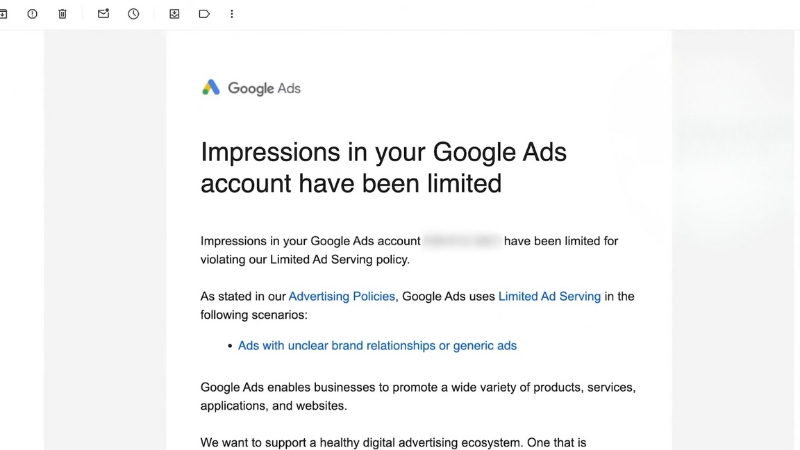
Limited advertising is rarely caused by a single factor. It usually appears when several risk indicators overlap.
Understanding these triggers precisely matters because incorrect fixes can extend the limitation period.
Traffic Source Instability
Ad networks closely monitor how users arrive on a site. Sudden spikes from social media, push notifications, paid traffic networks, or link shorteners raise flags, especially if those users bounce quickly or show low engagement.
A blog that normally receives 5,000 organic visits per day and suddenly jumps to 25,000 visits from Facebook groups or Telegram channels can trigger automated restrictions within 24 to 72 hours.
Insufficient Publisher Transparency
Missing or weak trust signals are one of the most underestimated causes. Sites without a clear About page, author attribution, contact information, privacy policy, and consent framework appear high-risk to advertisers.
This became more pronounced after GDPR enforcement actions in Europe between 2019 and 2023, when ad platforms tightened compliance requirements globally.
New or Recently Changed Sites

New domains, major redesigns, CMS migrations, or monetization changes often lead to temporary ad limits. Ad networks rely on historical data.
When that data resets or becomes inconsistent, ads are restricted until enough behavioral signals accumulate again.
Invalid Traffic Patterns
Invalid traffic does not mean fraud in the criminal sense. It often includes repeated page refreshes, bot traffic from data centers, VPN-heavy audiences, or misconfigured analytics filters.
Google’s 2023 invalid traffic documentation explicitly states that even unintentional patterns can lead to temporary serving limitations.
How to Confirm the Root Cause Instead of Guessing
Most publishers lose time by applying generic fixes. A structured diagnosis saves weeks.
Diagnostic Signal
What It Usually Indicates
Where to Check
Revenue drops with stable traffic
Ad eligibility issue
AdSense reports
High bounce rate from one source
Low-quality or incentivized traffic
Google Analytics
Sudden geographic shift
Proxy or paid traffic
Analytics location reports
Repeated warnings, but no email
Automated risk detection
Policy center
Low ads.txt trust
Inventory verification issue
Ads.txt validator
The absence of a policy violation email does not mean compliance is perfect. Limited ads often appear without direct warnings.
Traffic Quality Is the Primary Recovery Lever
View this post on Instagram
Ad platforms prioritize advertiser protection. Improving traffic quality is, therefore, the fastest path to recovery, but only when done measurably.
Organic search traffic remains the most trusted source. According to Similarweb and Google publisher disclosures from 2024, sites with more than 60 percent organic traffic recover from limited ads serving roughly 30 percent faster than sites dominated by social or referral traffic.
Removing or pausing paid traffic campaigns, click exchanges, and aggressive content distribution is essential. Even well-intentioned boosts, such as newsletter swaps or viral Reddit posts, can prolong restrictions if engagement metrics remain weak.
Content and Site Trust Signals That Actually Matter
Many publishers focus on content volume instead of trust clarity. Ad systems evaluate structure as much as substance.
A site should clearly show who is behind it, how content is produced, and how users can make contact. Author bios, editorial policies, and visible update dates matter because they help algorithms classify the site as a legitimate publishing entity rather than a disposable traffic container.
The table below outlines trust elements and their practical impact.
Trust Element
Impact on Ad Eligibility
Time to Reflect in Systems
Privacy policy with consent
High
3–10 days
Author attribution
Medium
1–2 weeks
Contact page
Medium
1–2 weeks
Consistent publishing cadence
Medium
2–4 weeks
Domain age over 6 months
High
Ongoing
Technical Compliance That Directly Affects Ads Serving
Technical misalignment often delays recovery even after traffic improves. Ads.txt is a frequent weak point. Missing or incorrect entries prevent advertisers from bidding confidently, which reduces fill and prolongs limitations.
Why the updates:
– Consent choices requirements are part of regulatory changes and evolving privacy expectations. Your legal and privacy teams can provide further guidance.– Consent mode enables your users’ consent choices to be passed to Google.
– We’re strengthening the…
— AdsLiaison (@adsliaison) February 13, 2024
Consent Management Platforms became non-optional after Google’s 2024 Consent Mode v2 rollout. Sites serving ads to users in the EU, UK, or EEA without valid consent signals often experience silent ad limitations rather than explicit policy violations.
Page speed and layout stability also matter. Excessive ad density, layout shifts, and ads above the fold that push content down can trigger user experience penalties that indirectly affect serving eligibility.
Timeline Expectations Based on Real Publisher Data
Recovery is not instant. Ad networks deliberately delay reinstatement to ensure issues are resolved.
Publisher Scenario
Typical Recovery Time
New site under 3 months
4–8 weeks
Traffic source cleanup only
2–4 weeks
Policy and compliance fixes
1–3 weeks
Repeated prior limitations
6–12 weeks
Manual review requested
Variable
Publishers who repeatedly trigger limitations often see diminishing trust, which extends future recovery windows.
Why Earnings Sometimes Do Not Fully Return
Even after ads serving normalize, RPMs may remain lower. This is because advertiser trust recalibrates slowly. Some demand partners temporarily exclude previously limited inventory, especially in sensitive niches like health, finance, or AI-generated content.
Gradual recovery is normal. Many publishers report reaching 70 to 85 percent of prior earnings within the first month, with full recovery taking two to three months if traffic quality remains stable.
Long-Term Prevention Strategies That Actually Work
Prevention is not about avoiding growth. It is about controlled growth. Stable traffic increases, diversified sources, and transparent site ownership reduce future limitations significantly.
Publishers who maintain clean analytics filters, avoid sudden monetization changes, and document content ownership publicly experience fewer limitations according to Google Ad Manager publisher surveys from 2023 and 2024.
Final Check
@the_google_pro Google Ads Mystery Solved: Eligible (Limited) Bid Strategy Status Running Google Ads and freaking out about this confusing message? Don’t worry, I’ve got you covered! In this short clip from the latest episode of Inside Google Ads, I break down what “Eligible (Limited)” bid strategy status means and how to fix it: What’s the Deal with “Limited” Bid Strategies? – This can happen for a few reasons, like low search volume or your chosen bid strategy itself. Basically, your ads might not be reaching as many people as you’d like. How Do I Fix It? – Simple! Check the “Status” column in Google Ads. It often includes Google’s recommendations for fixing the limitation. You can also consider switching to automated bid strategies like Max Conversions or Target CPA for better optimization. Are My Ads Still Showing? – Absolutely! Even with “Limited” status, your ads are still eligible. They just might be a little shy, hehe. Feeling lost in the Google Ads trenches? Inside Google Ads is here to help! I tackle your real questions every week and offer actionable tips to get your campaigns running smoothly. Head over to your favorite podcast app to listen to the full episode or grab the free transcript at jyll.ca/InsideGoogleAds #thegooglepro #InsideGoogleAds #yt #Troubleshooting #MarketingPodcast #AdWords #GoogleAdsBidding #BidStrategy #AutomatedBidding #GoogleAdsHelp #AdWords ♬ original sound – Jyll | Google Ads Expert 🇨🇦
Limited ads serve as a risk-control mechanism, not a punishment. The fix is procedural, not emotional. Publishers who treat it as a system trust issue and respond with measurable improvements recover consistently.
Those who chase shortcuts, traffic spikes, or cosmetic fixes often extend the restriction period. The difference lies in understanding how ad platforms evaluate risk and aligning the site accordingly.