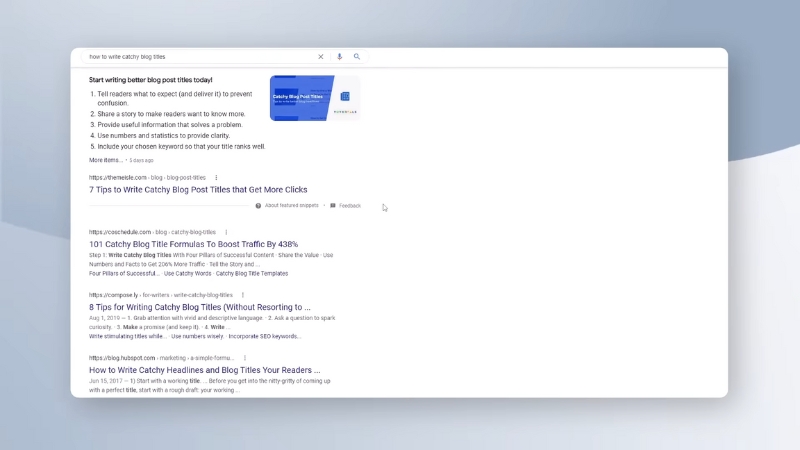
SEO titles that win Top 3 rankings in 2025 are not built around exact-match keywords anymore. They are built around semantic clarity, search intent alignment, and predictable emotional triggers that match what users actually want to accomplish.
The highest-performing titles today combine four elements at once:
- a clear topical entity
- an implied outcome or solution
- semantic relevance rather than pure keyword repetition
- phrasing that mirrors how real people think and search
Titles that still rely on stiff keyword stacking are steadily losing click-through rate and long-term ranking stability. Titles written with semantic intent now outperform even when ranking positions are equal.
What an SEO Title Really Does in Modern Search
An SEO title no longer serves only as a ranking signal. It now functions as a ranking influencer, CTR amplifier, and expectation-setter simultaneously.
Google evaluates how users react to your title in live search results. If users consistently prefer your result over others, even when you rank lower initially, your position often improves automatically.
Your title must therefore satisfy two audiences at once:
- the algorithm, which evaluates semantic relevance
- the human reader, who decides whether to click
If either side fails, your ranking ceiling drops.
Why Semantics Now Matter More Than Exact Keywords

Google no longer ranks pages only by matching strings of words. It ranks based on topic understanding. This includes meaning, relationships between concepts, and contextual phrasing.
That means your title must communicate what the page is really about, not just repeat the same keyword phrase.
For example, a page about hydration during heat stress does not need the exact phrase “hydration during heat stress” to rank. It can rank semantically with phrasing such as:
- “Why Horses Dehydrate Faster in Extreme Heat”
- “How Heat Impacts Electrolyte Balance in Horses”
- “Hydration Breakdown During Prolonged Heat Exposure”
These titles rank because they communicate the same topic from different semantic angles.
The Semantic Framework Behind Top-Ranking Titles
View this post on Instagram
High-performing SEO titles in 2025 follow a predictable semantic structure, even though they look creative on the surface. This structure contains:
- Primary entity (what the topic is about)
- Contextual modifier (why it matters or when it applies)
- Outcome or payoff (what the reader gains)
This format allows your title to rank across multiple related queries, not just one.
Semantic Title Composition
| Component | Purpose | Example |
| Primary entity | Defines topic | “Internal Linking” |
| Context modifier | Adds relevance | “for Blog Websites.” |
| Outcome trigger | Creates intent | “That Builds Topic Authority” |
This single structure allows one title to rank across dozens of long-tail variations.
How Semantic Titles Increase Click-Through Rate (CTR)

CTR is now one of the strongest secondary ranking reinforcers. Semantic titles increase CTR because they:
- match how users internally phrase their problems
- answer a question implicitly
- signal usefulness before the click
- Avoid robotic keyword stuffing.
Users no longer click the most optimized-looking title. They click the title that feels most accurate to their intent.
Compare the difference in user psychology between:
- “Best SEO Title Writing Guide 2025”
- “How to Write SEO Titles That Actually Win the Click in 2025”
The second outperforms because it speaks in outcomes, not categories.
Semantic Variants Let One Page Rank for Dozens of Queries
@maryannedamarzo 📍Episode 16 | Do you feel like a certain page is not doing so well? Query counting allows you to know what keywords are ranking for on your website. This could help you in updating and optimising keywords for that specific page so that it performs better on Google Search. #marketing #marketer #SEO #googlesearch #googlekeyword #searchengine #searchenginemarketing #digitalmarketing #seomarketing #googletips #edutok #learnontiktok #learnmarketing #googlesearchconsole #keywordsearch ♬ Pretty Girls Walk – Big Boss Vette
When your title is semantically flexible, it allows the page to rank for:
- informational queries
- solution-oriented queries
- comparison queries
- beginner-level searches
- advanced technical searches
This is why single-page topical dominance is possible today without writing 20 separate articles.
Keyword vs Semantic Title Targeting
| Keyword-Stuffed Title | Semantic Title |
| “Best On-Page SEO Checklist 2025” | “On Page SEO Checklist for 2025 That Fixes Ranking Bottlenecks” |
| “Internal Links SEO Guide Blog” | “Internal Linking Strategy That Builds Real Topic Authority” |
| “Permalink Structure SEO” | “Perfect Permalink Structure for Clean Architecture and Higher CTR” |
Semantics widens your ranking footprint automatically.
How Google Evaluates Title Rewrites and Replacements

Google now rewrites a large percentage of SEO titles in the SERP. This happens when: The title is over-optimized.
- The title does not match the page intent
- The wording is deceptive
- The title lacks semantic alignment with the content
If your title is being rewritten by Google, that is a visible signal of semantic failure. The algorithm is telling you that your phrasing does not represent the page accurately enough for user trust.
Pages whose titles are not rewritten consistently show higher CTR stability.
How Long SEO Titles Should Be in 2025
Title length still matters, but not as a fixed character rule. What matters is semantic density within visible space.
Title Length Performance
| Length Range | Performance Outcome |
| Under 40 characters | Often incomplete context |
| 50–60 characters | Optimal balance |
| 61–70 characters | Still safe if semantically dense |
| Over 75 characters | Truncation risk and CTR loss |
If your key semantic payload appears before truncation, the length can extend safely.
Emotional Triggers That Still Work Without Clickbait

Clickbait fails long-term because it misaligns expectations with reality. But emotional triggers still work when paired with semantic accuracy.
High-performing triggers include:
- certainty (“the real reason”, “what actually works”)
- urgency (“before you publish”, “after ranking drops”)
- clarity (“explained simply”, “without guesswork”)
- authority (“data-backed”, “tested on live sites”)
Used sparingly, they increase CTR without harming trust.
Common Title-Writing Mistakes That Cap Rankings
Even the strongest content can have its rankings capped by weak title construction. One of the most common problems is repeating the same keyword twice within a single title, which reduces semantic clarity and often triggers partial devaluation rather than reinforcement.
Another frequent mistake is stacking multiple years unnaturally, such as combining outdated references with current ones, which makes the title look manipulated and lowers user trust before the click even happens.
Many titles also suffer from filler words that add length but weaken intent, creating titles that sound optimized but say very little. A particularly damaging mistake is writing titles that function as category labels instead of outcome-driven promises, which removes the psychological reason for the user to click.
Finally, vague modifiers such as “ultimate” or “complete” frequently fail when they are used without visible proof or clear scope, because modern users have grown skeptical of exaggerated claims that do not immediately explain what makes the content different or valuable.
High-Impact Title Errors
| Mistake | Ranking Impact |
| Keyword duplication | Semantic suppression |
| Year stuffing | CTR reduction |
| Filler phrases | Intent dilution |
| Vague adjectives | Trust loss |
Conclusion
In 2025, SEO titles no longer win through keyword density. They win through semantic precision, intent alignment, and behavioral confirmation through CTR.
The strongest titles communicate meaning first and optimization second.
If your titles are written only for algorithms, your rankings will plateau. If they are written semantically for human intent, your rankings gain elasticity and expand across dozens of related queries automatically.