If you want your blog posts to rank higher in 2025, you must add schema markup using JSON-LD, because Google now relies heavily on structured data to understand your content, its purpose, and how it should appear in search results.
JSON-LD is the preferred format for schema because it keeps your HTML clean, improves site speed, and allows Google’s crawlers to interpret your blog instantly.
The concrete truth is this: blogs that use properly validated schema outperform blogs that rely on unstructured content alone, especially in competitive niches.
Adding Article, Breadcrumb, FAQ, and Author schema gives Google explicit signals that help your content qualify for rich results and stronger visibility.
Most bloggers mistakenly assume schema is “technical” or “optional.” In 2025, it’s neither. Schema markup is now a foundation of modern SEO, and JSON-LD makes it simple, predictable, and clean.
What Schema Markup Actually Does for Your Blog
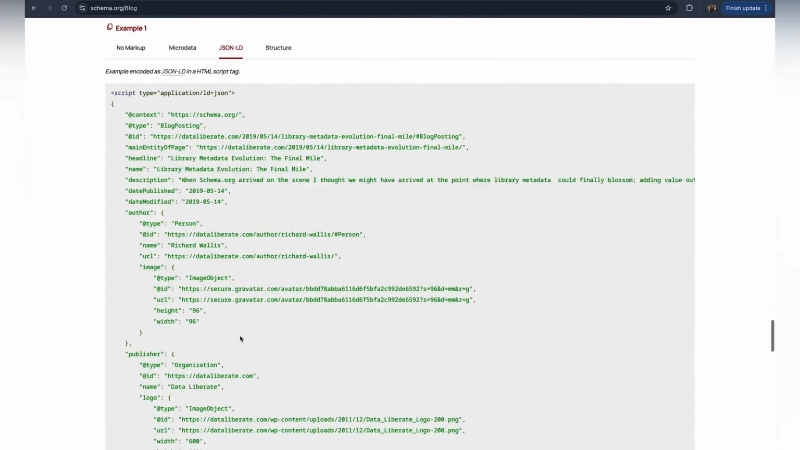
Schema markup is a standardised language that search engines read behind the scenes. While your readers enjoy your paragraphs and headings, Google needs structured signals that describe the page in a precise, machine-readable way.
Schema markup gives search engines information that is difficult to infer purely from text, details like the article’s category, the publication date, the author, the featured image, the brand behind the website, and even whether the content answers a series of FAQs.
When you add schema, you give Google context:
- You clarify that the page is a blog post, not a product page.
- You clarify who wrote it, which matters for E-E-A-T.
- You clarify which part of the content is instructional, which part is a question-and-answer section, and which part belongs to the website’s structure.
This level of transparency makes your blog eligible for enhanced search results such as breadcrumb displays, FAQ dropdown sections, how-to formatting, or richer article previews.
Even when the schema does not produce a visible change in the SERP, it still helps Google interpret your content more efficiently, which leads to more stable rankings over time.
Why JSON-LD Is the Best Format in 2025
There are several ways to add schema to a website, but JSON-LD is the official, recommended, and future-proof method. It separates structured data from your website’s visible content, which keeps your layout clean and prevents schema from breaking whenever you update your design, theme, or content structure.
JSON-LD does not rely on micro-tags scattered throughout your HTML. Instead, it exists as one organised block of information that sits inside the page header or footer.
This makes it easier to edit, scale, and manage, especially on a blog that publishes content frequently. Because Google’s crawlers read JSON-LD directly, without needing to interpret contextual signals, it improves indexing speed and reduces errors.
Another advantage is stability. Themes, plugins, and visual page editors often introduce messy code, but JSON-LD remains consistent no matter how your blog layout changes. For long-term SEO and technical clean-up, JSON-LD is the safest format to work with.
The Most Important Schema Types for Blog Websites
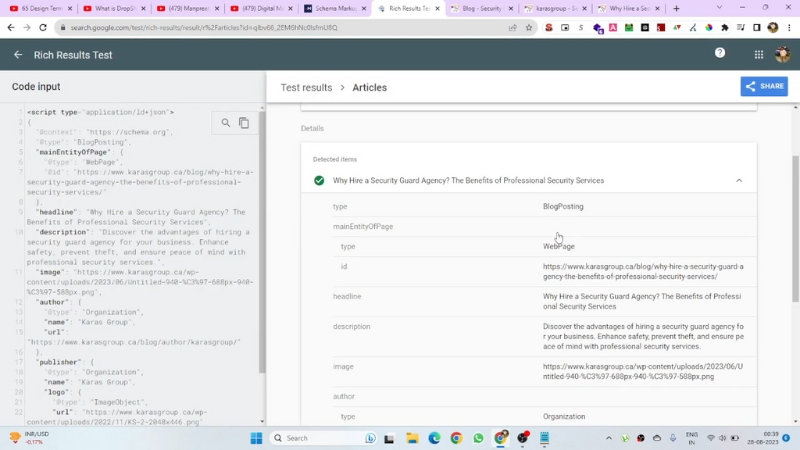
A modern blog does not need dozens of schema types. It needs the right ones. Google evaluates blogs differently from e-commerce or corporate sites, which means the essential schema categories are simple but extremely effective.
The foundation is the Article schema, which tells Google that your page is a piece of written content with a title, author, publication date, modification date, and main topic. This is the schema that unlocks eligibility for article-style rich previews.
Breadcrumb schema is equally important because it helps Google understand your site’s structure and hierarchy: category → subcategory → article. A clean breadcrumb trail can reduce crawling confusion and improve how your site appears in results.
The FAQ schema is useful when your content includes a Q&A section. Google displays these questions as collapsible elements directly in the search results when properly formatted. For tutorials or step-by-step content, the How-To schema helps Google distinguish each step and understand the instructional flow.
Meanwhile, the Organization and Author schema strengthen site credibility by giving Google consistent signals about who publishes and who writes your content.
Schema Types That Matter Most for Bloggers
| Schema Type | Purpose in 2025 | Why It Helps Blog SEO |
| Article / BlogPosting | Defines your content type | Enables rich article results |
| BreadcrumbList | Shows content hierarchy | Improves SERP appearance |
| FAQPage | Marks Q&A sections | Unlocks FAQ rich results |
| HowTo | Structures tutorials | Helps Google interpret instructions |
| Author | Identify the writer’s details | Supports E-E-A-T signals |
| Organization | Connects all posts under one brand | Strengthens authority |
| ImageObject | Describes featured images | Improves image indexing |
| WebPage | Defines general metadata | Enhances overall clarity |
Where to Place Schema on Your Blog
View this post on Instagram
One advantage of JSON-LD is that you can place it in a single block anywhere within your <head> or at the bottom of your <body> section. Most modern CMS systems, such as WordPress, allow you to insert schema markup using theme settings, SEO plugins, or custom fields without touching the design.
If using plugins like RankMath, Yoast, SEOPress, or Schema Pro, these tools automatically generate the basic portion of your structured data.
However, even if your plugin creates a default schema, you may still need to customise or add extra structured data for specific posts, such as FAQ or How-To schema.
The most efficient workflow for most blogs is:
How to Validate Schema Correctly Before Publishing
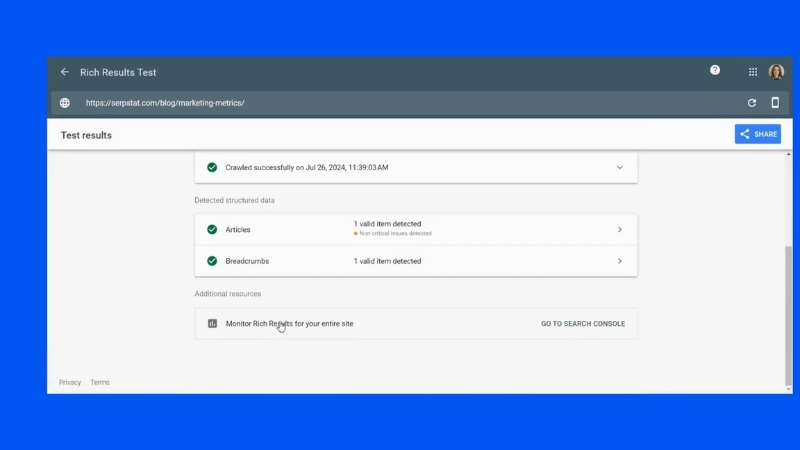
Writing a schema is only half the process. You must validate it to ensure Google accepts it. Validation is not optional; an incorrect schema can be ignored, flagged, or cause your rich results to be removed entirely.
Google offers two reliable tools:
Google’s Rich Results Test
This tool checks whether your structured data qualifies for specific rich result formats. It identifies missing fields, invalid values, and compatibility issues.
Schema.org Validator
This tool verifies whether your JSON-LD is syntactically correct and follows schema vocabulary properly. It does not check rich result eligibility, but it ensures the code itself is valid.
Validation flags common mistakes such as incorrect date formatting, missing required fields, duplicate schema types, mismatched URLs, or publisher details that do not match the website’s identity.
Most validation errors are simple to fix once you know what is missing.
Common Schema Validation Errors and How to Fix Them
| Problem | Cause | Fix |
| Missing required fields | Headline, author, or image left out | Add those elements to the Article schema |
| Invalid date format | Wrong style (e.g., MM/DD/YYYY) | Use YYYY-MM-DD format |
| Duplicate schema | Plugin + manual schema overlap | Disable plugin auto-schema for that post |
| Incorrect publisher info | Logo missing or wrong URL | Add logo URL and organization name |
| Broken FAQ structure | Questions not paired with answers | Ensure each Q has a corresponding A |
Why Schema Improves Ranking Stability
@thewizardmarketing schema markup is a quick and easy thing to fix, and if you do it right you are going to gain ranking positions and impressions over time #schema #marketing ♬ original sound – Jake | The Marketing Wizard
Schema markup does not magically push your article to page one. However, it improves ranking stability, especially after algorithm updates, because it reduces ambiguity.
Modern search engines reward predictable, structured content. When Google understands exactly what your page contains, it becomes easier to categorize, compare, contextualize, and trust.
Structured data also helps Google generate search features that pull attention away from competitors. A blog post with breadcrumb formatting, an expanded FAQ preview, or a clean article snippet draws more clicks even without moving up in rank.
In a world where AI search summaries increasingly reduce clicks to generic results, blogs need every technical advantage they can get. Schema markup, especially in JSON-LD form, provides exactly that.
Conclusion
Adding schema markup with JSON-LD is not a technical afterthought; it is one of the core requirements for SEO success in 2025.
It simplifies Google’s understanding of your content, increases your eligibility for rich results, and strengthens your blog’s credibility.
When combined with strong writing, clear structure, fast mobile performance, and consistent internal linking, schema markup becomes part of the foundation that allows your content to rank higher and hold those rankings longer.